1995 — 1999
A degree — and the problem of delivery
SUNY at Stony Brook · B.S. in Biochemistry
What was the challenge?
It was not simply choosing a drug, vitamin or enzyme. The challenge was finding a way to
carry it through the body toward the tissue where it was intended to act.
The research
Dr. Aronov’s undergraduate research explored how hyaluronic acid–based polymer
systems could serve as delivery vehicles for drugs, vitamins and enzymes.
What lasted
The substance itself is only part of the story. Its route, delivery, behavior inside the
body, and the individual patient’s response all help shape what happens next.
Introducing a compound into the body is only the first step. Understanding what happens
next is where the real science — and the responsibility — begin. That
principle would follow Dr. Aronov from the research bench into the operating room, and
ultimately into the practice founded here.
1997 — 1999
What tells an injured nerve to begin repairing itself?
Regeneron Pharmaceuticals · Tarrytown, NY
The question was microscopic. Its implications were anything but.
During the final two years of a biochemistry degree at SUNY Stony Brook, Dr. Aronov
entered pharmaceutical research at Regeneron, studying the cellular science behind nerve
repair and recovery after injury.
There, it became clear how discoveries made inside a laboratory could one day change what
happens at a patient’s bedside. That possibility became the bridge from research
into medicine.
1999 — 2004
Doctor of Osteopathic Medicine
NYCOM at New York Institute of Technology
At NYCOM, Dr. Aronov learned to look beyond the location of pain and ask a more revealing
question: what else in the body may be influencing it?
Osteopathic medical training emphasized anatomy, the musculoskeletal system, and the
relationship between structure and function. That foundation continues to shape
Dr. Aronov’s whole-patient approach to physician-directed, supportive IV care.
Her infusions complement, rather than replace, care from a specialist or primary physician.
2004 — 2008
Anesthesiology residency
Nassau University Medical Center · East Meadow, New York
Anesthesiology taught Dr. Aronov that IV medicine leaves no room for casual decisions.
During four years of intensive training in physiology, pharmacology, airway management
and critical care taught Dr. Aronov to recognize subtle changes, anticipate complications
and act decisively when seconds matter.
That same discipline now guides every patient screening, medication selection, dose and
infusion Dr. Aronov personally oversees.
Clinical training affiliates
Winthrop University Hospital
South Nassau Communities Hospital
St. Francis Hospital
2008 — Present
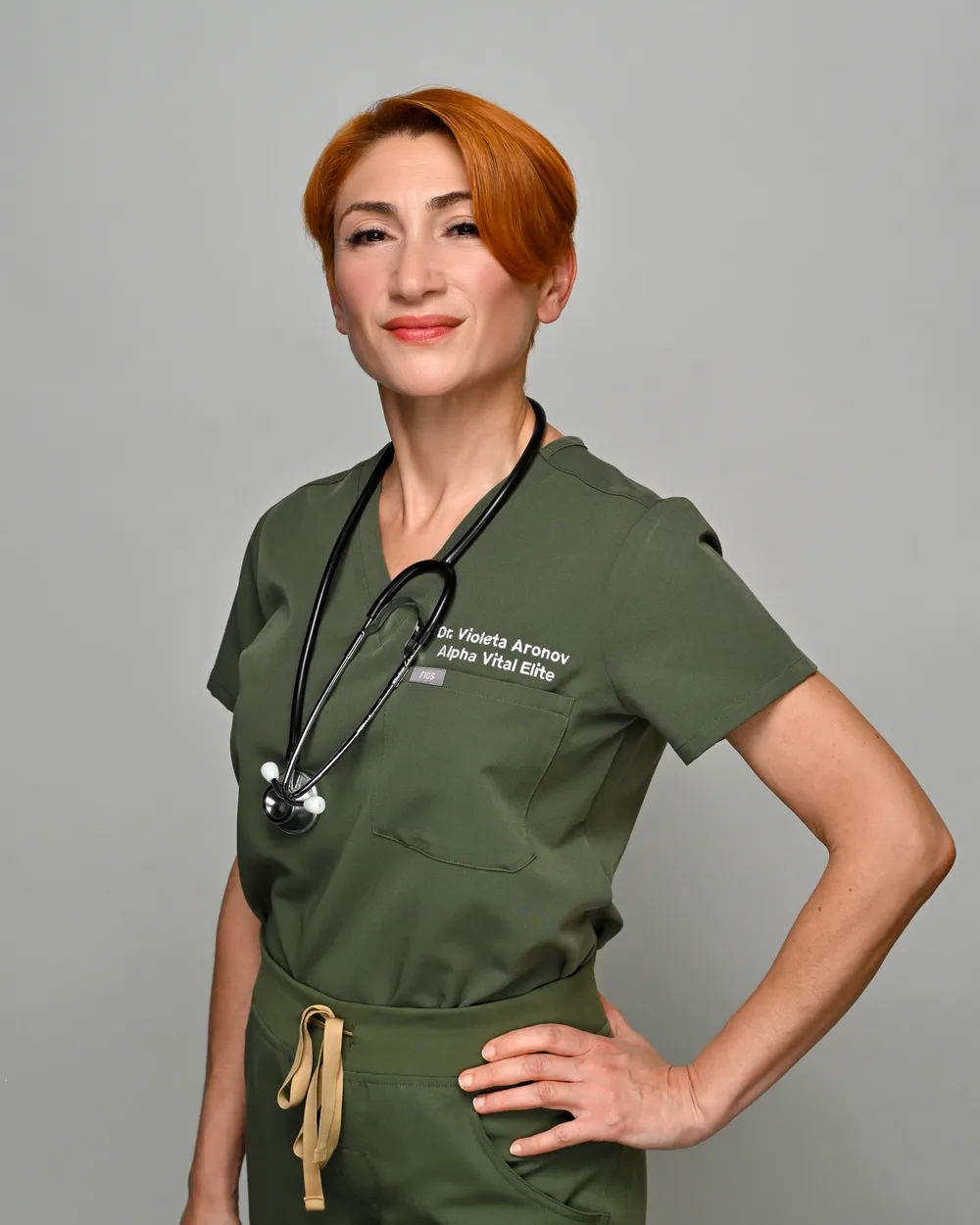
Nearly two decades in the operating room
General · OB/GYN · Vascular · GI · Pediatric · Orthopedic · Urology
What does nearly two decades in the operating room teach you about an IV? That the
bag is the simplest part.
In clinical anesthesiology, every medication, fluid and electrolyte can affect breathing,
blood pressure, heart rhythm and cardiovascular stability — sometimes within
seconds. Dr. Aronov’s work has required anticipating those changes, recognizing
subtle warning signs, and responding before they become emergencies.
That experience changes how you approach an IV. You do not begin with what can be added
to the bag. You begin with the person receiving it — their medical history,
medications, symptoms, hydration status, and whether an infusion is appropriate at all.
Alpha Vital Elite brings that operating-room standard into an outpatient setting —
to you.